On Graph Neural Networks versus Graph-Augmented MLPs
Abstract
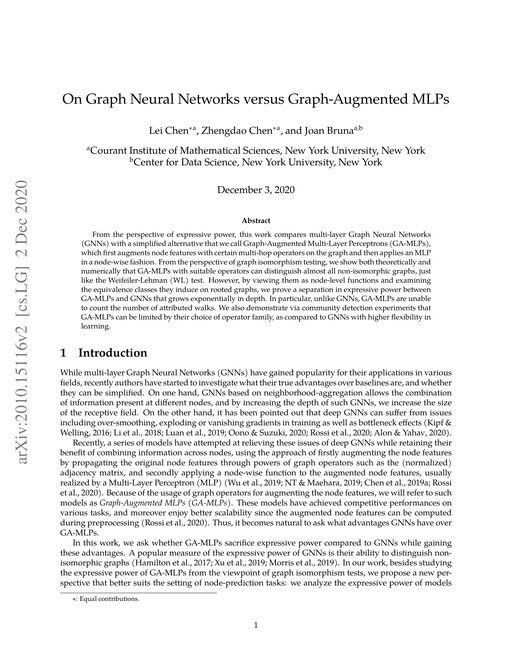
From the perspective of expressive power, this work compares multi-layer Graph Neural Networks (GNNs) with a simplified alternative that we call Graph-Augmented Multi-Layer Perceptrons (GA-MLPs), which first augments node features with certain multi-hop operators on the graph and then applies an MLP in a node-wise fashion. From the perspective of graph isomorphism testing, we show both theoretically and numerically that GA-MLPs with suitable operators can distinguish almost all non-isomorphic graphs, just like the Weifeiler-Lehman (WL) test. However, by viewing them as node-level functions and examining the equivalence classes they induce on rooted graphs, we prove a separation in expressive power between GA-MLPs and GNNs that grows exponentially in depth. In particular, unlike GNNs, GA-MLPs are unable to count the number of attributed walks. We also demonstrate via community detection experiments that GA-MLPs can be limited by their choice of operator family, as compared to GNNs with higher flexibility in learning.
Benchmark Results
Tested on 2 datasets Non-standard metric on 2 datasets
Tables show presented results in global context (best 3 papers + GCN + MLP).
TU Dortmund
COLLAB
Global leaderboard →Sorted by equivalence classes. Highlighted rows are from other papers.
| # | Model | equivalence classes ↓ | Paper |
|---|---|---|---|
| 1 | GNN | 294.0000 | This paper |
| 2 | GA-MLP | 294.0000 | This paper |
IMDB-MULTI
Global leaderboard →Sorted by equivalence classes. Highlighted rows are from other papers.
| # | Model | equivalence classes ↓ | Paper |
|---|---|---|---|
| 1 | GNN | 387.0000 | This paper |
| 2 | GA-MLP | 387.0000 | This paper |