Decimated Framelet System on Graphs and Fast $ $-Framelet Transforms
Abstract
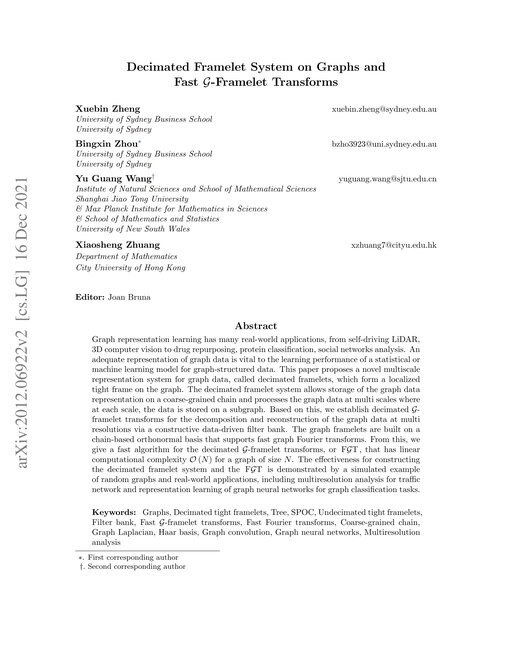
Graph representation learning has many real-world applications, from self-driving LiDAR, 3D computer vision to drug repurposing, protein classification, social networks analysis. An adequate representation of graph data is vital to the learning performance of a statistical or machine learning model for graph-structured data. This paper proposes a novel multiscale representation system for graph data, called decimated framelets, which form a localized tight frame on the graph. The decimated framelet system allows storage of the graph data representation on a coarse-grained chain and processes the graph data at multi scales where at each scale, the data is stored on a subgraph. Based on this, we establish decimated $ $-framelet transforms for the decomposition and reconstruction of the graph data at multi resolutions via a constructive data-driven filter bank. The graph framelets are built on a chain-based orthonormal basis that supports fast graph Fourier transforms. From this, we give a fast algorithm for the decimated $ $-framelet transforms, or, that has linear computational complexity $ N$ for a graph of size $N$. The effectiveness for constructing the decimated framelet system and the is demonstrated by a simulated example of random graphs and real-world applications, including multiresolution analysis for traffic network and representation learning of graph neural networks for graph classification tasks.
Benchmark Results
Tested on 2 datasets
Tables show presented results in global context (best 3 papers + GCN + MLP).
TU Dortmund
| # | Model | Accuracy ↑ | Paper |
|---|---|---|---|
| 1 | MSH-GNN | 0.9910
±0.0030 | |
| 2 | ID-GNN+BEC | 0.9830
±0.0360 | |
| 3 | SupCosine | 0.9830
±0.0250 | |
| 39 | GIN | 0.9330
±0.0290 best reported | best at pub: Provably Powerful Graph Networks (NeurIPS 2019) best today: ProtGNN: Towards Self-Explaining Graph Neural Networks (AAAI 2021) Difference within reported uncertainty; not counted as underperformance. |
| 63 | GCN | 0.9220
±0.0440 | |
| 134 | FGConv-Sum | 0.9080
±0.0250 | This paper |
| 403 | MLP | 0.8660
±0.0495 |
| # | Model | Accuracy ↑ | Paper |
|---|---|---|---|
| 1 | GC-GNN (GCN) | 0.9210
±0.0810 | |
| 2 | SUGAR | 0.8403
±0.0133 | |
| 3 | Ortho-g-U-Nets | 0.8387 | |
| 5 | FGConv-Sum | 0.8290
±0.0255 | This paper |
| 15 | SAGE | 0.8088
±0.0233 |