Handling Distribution Shifts on Graphs: An Invariance Perspective
Abstract
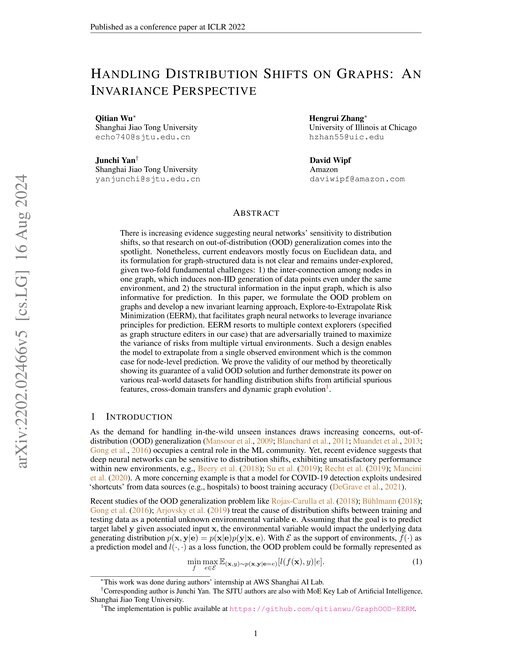
There is increasing evidence suggesting neural networks' sensitivity to distribution shifts, so that research on out-of-distribution (OOD) generalization comes into the spotlight. Nonetheless, current endeavors mostly focus on Euclidean data, and its formulation for graph-structured data is not clear and remains under-explored, given two-fold fundamental challenges: 1) the inter-connection among nodes in one graph, which induces non-IID generation of data points even under the same environment, and 2) the structural information in the input graph, which is also informative for prediction. In this paper, we formulate the OOD problem on graphs and develop a new invariant learning approach, Explore-to-Extrapolate Risk Minimization (EERM), that facilitates graph neural networks to leverage invariance principles for prediction. EERM resorts to multiple context explorers (specified as graph structure editers in our case) that are adversarially trained to maximize the variance of risks from multiple virtual environments. Such a design enables the model to extrapolate from a single observed environment which is the common case for node-level prediction. We prove the validity of our method by theoretically showing its guarantee of a valid OOD solution and further demonstrate its power on various real-world datasets for handling distribution shifts from artificial spurious features, cross-domain transfers and dynamic graph evolution..
Benchmark Results
Tested on 1 dataset
Tables show presented results in global context (best 3 papers + GCN + MLP).
Heterophilic Graphs
| # | Model | Accuracy ↑ | Paper |
|---|---|---|---|
| 1 | P^2GNN | 0.9672
±0.0147 | |
| 2 | DoG | 0.9660
±0.0210 | |
| 3 | GPF-plus | 0.9583
±0.0419 | |
| 34 | MLP | 0.9230
±0.0070 | |
| 53 | GraphSAGE | 0.9000
±0.0365 | |
| 558 | ERM | 0.5625
±0.0013 | This paper |
| 561 | EERM | 0.5612
±0.0042 | This paper |