Equivariant Matrix Function Neural Networks
Abstract
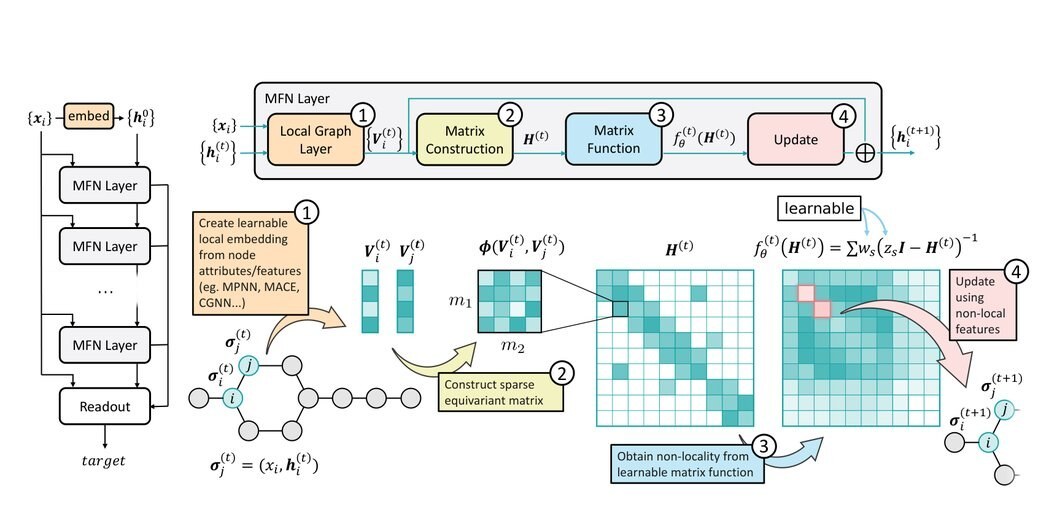
Graph Neural Networks (GNNs), especially message-passing neural networks (MPNNs), have emerged as powerful architectures for learning on graphs in diverse applications. However, MPNNs face challenges when modeling non-local interactions in graphs such as large conjugated molecules, and social networks due to oversmoothing and oversquashing. Although Spectral GNNs and traditional neural networks such as recurrent neural networks and transformers mitigate these challenges, they often lack generalizability, or fail to capture detailed structural relationships or symmetries in the data. To address these concerns, we introduce Matrix Function Neural Networks (MFNs), a novel architecture that parameterizes non-local interactions through analytic matrix equivariant functions. Employing resolvent expansions offers a straightforward implementation and the potential for linear scaling with system size. The MFN architecture achieves state-of-the-art performance in standard graph benchmarks, such as the ZINC and TU datasets, and is able to capture intricate non-local interactions in quantum systems, paving the way to new state-of-the-art force fields. The code and the datasets will be made public.
Benchmark Results
Tested on 3 datasets
Tables show presented results in global context (best 3 papers + GCN + MLP).
TU Dortmund
| # | Model | Accuracy ↑ | Paper |
|---|---|---|---|
| 1 | MSH-GNN | 0.9910
±0.0030 | |
| 2 | ID-GNN+BEC | 0.9830
±0.0360 | |
| 3 | SupCosine | 0.9830
±0.0250 | |
| 39 | GIN | 0.9330
±0.0290 | |
| 93 | MFN | 0.9150
±0.0735 | This paper |
| 403 | MLP | 0.8660
±0.0495 |
| # | Model | Accuracy ↑ | Paper |
|---|---|---|---|
| 1 | MSH-GNN | 0.9410
±0.0330 | |
| 2 | GRDL | 0.8260
±0.0120 | |
| 3 | GMN | 0.8225 | |
| 32 | GIN | 0.7880
±0.0410 | |
| 141 | MFN | 0.7618
±0.0407 | This paper |
| 149 | MLP | 0.7600
±0.0320 |
| # | Model | Accuracy ↑ | Paper |
|---|---|---|---|
| 1 | GMN | 0.7866 | |
| 2 | MemGNN | 0.7550 | |
| 3 | TFGW SP | 0.7510
±0.0500 | |
| 9 | MFN | 0.7290
±0.0755 | This paper |
| 17 | GatedGCN | 0.7000
±0.0494 | |
| 26 | GraphSAGE | 0.6817
±0.0545 | |
| 124 | MLP | 0.5583
±0.0352 |