PREM: A Simple Yet Effective Approach for Node-Level Graph Anomaly Detection
Abstract
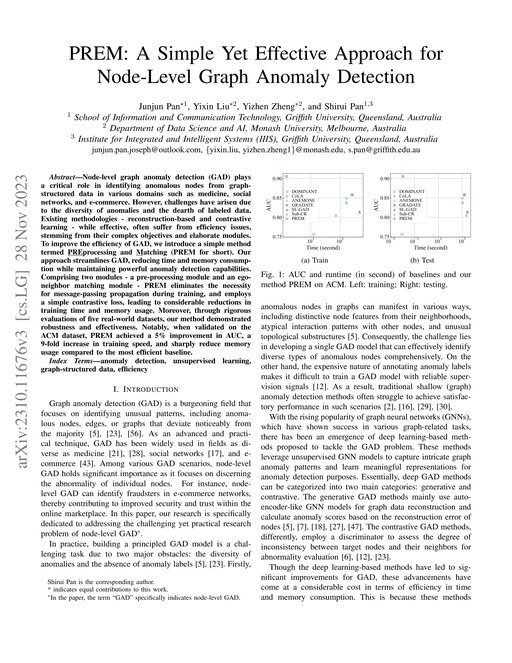
graph anomaly detection (GAD) plays a critical role in identifying in various domains such as medicine, social networks, and e-commerce. However, challenges have arisen due to the dearth of labeled data. Existing methodologies - reconstruction-based and contrastive learning - while effective, often suffer from efficiency issues, stemming from their complex objectives and elaborate modules. To improve the efficiency of GAD, we introduce a simple method termed processing and atching (PREM). Our approach streamlines GAD, Comprising two modules - a pre-processing module and an ego-neighbor matching module - PREM eliminates the necessity for message-passing propagation during training, and employs a simple contrastive loss, leading to considerable reductions in training time and memory usage. Moreover, through rigorous evaluations of five real-world datasets, our method demonstrated robustness and effectiveness. Notably, when validated on the ACM dataset, PREM achieved a 5\
Benchmark Results
Tested on 1 dataset Non-standard metric on 1 dataset
Tables show presented results in global context (best 3 papers + GCN + MLP).
Heterogeneous Graph Benchmarks
ACM
Global leaderboard →Sorted by AUC. Highlighted rows are from other papers.
| # | Model | AUC ↑ | Paper |
|---|---|---|---|
| 1 | PREM-b | 0.9088 | This paper |
| 2 | PREM | 0.9056 | This paper |
| 3 | GRADATE | 0.8580 | This paper |
| 4 | ANEMONE | 0.8492 | This paper |
| 5 | CoLA | 0.8375 | This paper |
| 6 | SL-GAD | 0.8143 | This paper |
| 7 | Sub-CR | 0.8060 | This paper |
| 8 | DOMINANT | 0.7561 | This paper |