Efficient End-to-end Language Model Fine-tuning on Graphs
Abstract
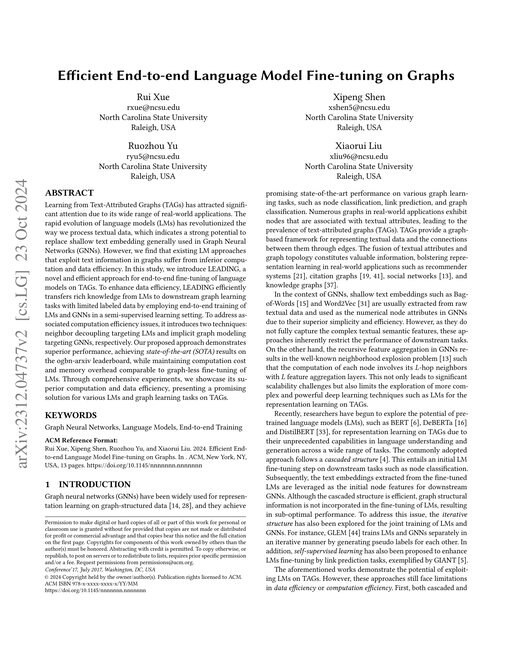
Learning from Text-Attributed Graphs (TAGs) has attracted significant attention due to its wide range of real-world applications. The rapid evolution of language models (LMs) has revolutionized the way we process textual data, which indicates a strong potential to replace shallow text embedding generally used in Graph Neural Networks (GNNs). However, we find that existing LM approaches that exploit text information in graphs suffer from inferior computation and data efficiency. In this study, we introduce LEADING, a novel and efficient approach for end-to-end fine-tuning of language models on TAGs. To enhance data efficiency, LEADING efficiently transfers rich knowledge from LMs to downstream graph learning tasks with limited labeled data by employing end-to-end training of LMs and GNNs in a semi-supervised learning setting. To address associated computation efficiency issues, it introduces two techniques: neighbor decoupling targeting LMs and implicit graph modeling targeting GNNs, respectively. Our proposed approach demonstrates superior performance, achieving state-of-the-art (SOTA) results on the ogbn-arxiv leaderboard, while maintaining computation cost and memory overhead comparable to graph-less fine-tuning of LMs. Through comprehensive experiments, we showcase its superior computation and data efficiency, presenting a promising solution for various LMs and graph learning tasks on TAGs.
Benchmark Results
Tested on 1 dataset
Tables show presented results in global context (best 3 papers + GCN + MLP).
OGB
| # | Model | MRR ↑ | Paper |
|---|---|---|---|
| 1 | CFG | 0.8997
±0.0015 | |
| 2 | SIEG | 0.8987
±0.0018 | |
| 3 | LPFormer | 0.8981
±0.0013 | |
| 12 | GCN | 0.8705
±0.0004 | |
| 19 | LEADING | 0.8520 | This paper |
| 29 | Supervised-FT | 0.8310 | This paper |
| 38 | Pre-trained | 0.8180 | This paper |
| 46 | SBERT | 0.7730 | This paper |
| 71 | MLP | 0.3917
±0.0044 |