The Heterophilic Snowflake Hypothesis: Training and Empowering GNNs for Heterophilic Graphs
Abstract
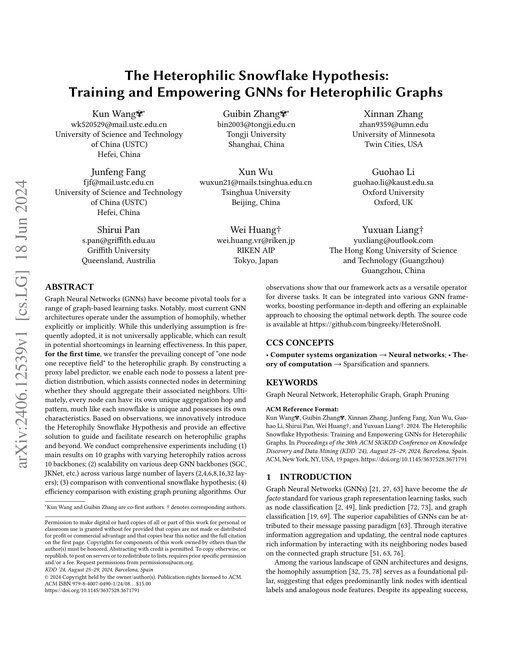
Graph Neural Networks (GNNs) have become pivotal tools for a range of graph-based learning tasks. Notably, most current GNN architectures operate under the assumption of homophily, whether explicitly or implicitly. While this underlying assumption is frequently adopted, it is not universally applicable, which can result in potential shortcomings in learning effectiveness. In this paper, for the first time, we transfer the prevailing concept of ``one node one receptive field" to the heterophilic graph. By constructing a proxy label predictor, we enable each node to possess a latent prediction distribution, which assists connected nodes in determining whether they should aggregate their associated neighbors. Ultimately, every node can have its own unique aggregation hop and pattern, much like each snowflake is unique and possesses its own characteristics. Based on observations, we innovatively introduce the Heterophily Snowflake Hypothesis and provide an effective solution to guide and facilitate research on heterophilic graphs and beyond. We conduct comprehensive experiments including (1) main results on 10 graphs with varying heterophily ratios across 10 backbones; (2) scalability on various deep GNN backbones (SGC, JKNet, etc.) across various large number of layers (2,4,6,8,16,32 layers); (3) comparison with conventional snowflake hypothesis; (4) efficiency comparison with existing graph pruning algorithms. Our observations show that our framework acts as a versatile operator for diverse tasks. It can be integrated into various GNN frameworks, boosting performance in-depth and offering an explainable approach to choosing the optimal network depth. The source code is available at.
Benchmark Results
Tested on 4 datasets SOTA at publication on 1 12 baseline values reported too low
Tables show presented results in global context (best 3 papers + GCN + MLP).
Heterophilic Graphs
| # | Model | Accuracy ↑ | Paper |
|---|---|---|---|
| 1 | P^2GNN | 0.9672
±0.0147 | |
| 2 | DoG | 0.9660
±0.0210 | |
| 3 | GPF-plus | 0.9583
±0.0419 | |
| 6 | Mixhop/ +Hetero-S | 0.9486 | This paper |
| 34 | MLP | 0.9230
±0.0070 | |
| 35 | H2GCN/ +Hetero-S | 0.9228 | This paper |
| 53 | GraphSAGE | 0.9000
±0.0365 | |
| 262 | GCN/ +Hetero-S | 0.7895 | This paper |
| 266 | GIN/ +Hetero-S | 0.7885 | This paper |
| 423 | Geom-GCN/ +Hetero-S | 0.6698 | This paper |
| 435 | GAT/ +Hetero-S | 0.6579 | This paper |
| # | Model | Accuracy ↑ | Paper |
|---|---|---|---|
| 1 | P^2GNN | 0.9541
±0.0272 | |
| 2 | ACM-GCN | 0.9480
±0.0380 | |
| 3 | RF-GCN | 0.9429 | |
| 24 | MLP | 0.9136
±0.0070 | |
| 35 | GCNII | 0.8918
±0.0396 best reported | best at pub: Convolutional Neural Networks on Graphs with Chebyshev Approximation, Revisited (NeurIPS 2022) best today: $P^2$GNN: Two Prototype Sets to boost GNN Performance (2026) |
| 68 | H2GCN | 0.8623
±0.0471 best reported | best at pub: Design your own universe: a physics-informed agnostic method for enhancing graph neural networks (2024) best today: $P^2$GNN: Two Prototype Sets to boost GNN Performance (2026) |
| 89 | GPNN | 0.8514
±0.0600 best reported | best at pub: Graph Pointer Neural Networks (AAAI 2021) |
| 138 | SAGE | 0.8269 | |
| 158 | GAT | 0.8190
±0.0540 best reported | best at pub: Restructuring Graphs for Higher Homophily via Adaptive Spectral Clustering (AAAI 2022) |
| 170 | GCN | 0.8082
±0.0360 best reported | best at pub: Differentiable Cluster Graph Neural Network (2024) best today: Bayesian Neighborhood Adaptation for Graph Neural Networks (TMLR 2025) |
| 183 | MixHop | 0.7950
±0.0630 best reported | best at pub: Label-Wise Graph Convolutional Network for Heterophilic Graphs (2021) Difference within reported uncertainty; not counted as underperformance. |
| 201 | GIN | 0.7800
±0.0190 best reported | |
| 241 | JKNet | 0.7443
±0.0830 best reported | best at pub: Oversmoothing alleviation in graph neural networks: a survey and unified view (2024) best today: Bayesian Neighborhood Adaptation for Graph Neural Networks (TMLR 2025) |
| 275 | MGNN/ +Hetero-S | 0.7122 | This paper |
| 287 | GCNII/ +Hetero-S | 0.6972 | This paper |
| 291 | Mixhop/ +Hetero-S | 0.6899 | This paper |
| 326 | H2GCN/ +Hetero-S | 0.6545 | This paper |
| 342 | Geom-GCN | 0.6412 best reported | best at pub: Steering Graph Neural Networks with Pinning Control (2023) |
| 351 | GPNN/ +Hetero-S | 0.6324 | This paper |
| 428 | MGNN | 0.5526 | This paper |
| 489 | JKNet/ +Hetero-S | 0.5007 | This paper |
| 497 | Geom-GCN/ +Hetero-S | 0.4899 | This paper |
| 511 | GCN/ +Hetero-S | 0.4737 | This paper |
| 554 | GAT/ +Hetero-S | 0.3976 | This paper |
| 558 | GIN/ +Hetero-S | 0.3842 | This paper |
| # | Model | Accuracy ↑ | Paper |
|---|---|---|---|
| 1 | Hetero-S (GAT 8-layer) | 0.8693 | This paper |
| 2 | Dir-GNN+CNA | 0.8586
±0.0180 | |
| 3 | GAT | 0.8560 | prev best: Restructuring Graphs for Higher Homophily via Adaptive Spectral Clustering (AAAI 2022) |
| 32 | JKNet | 0.7419 | prev best: Hierarchical Graph Transformer with Adaptive Node Sampling (NeurIPS 2022) |
| 52 | GCN | 0.7033 best reported | best at pub: Understanding Heterophily for Graph Neural Networks (ICML 2024) |
| 108 | SAGE | 0.6340
±0.0300 | |
| 163 | GPNN | 0.5529 | This paper |
| 169 | MLP | 0.5429 |
| # | Model | Accuracy ↑ | Paper |
|---|---|---|---|
| 1 | DMD++ | 0.9190
±0.0260 | |
| 2 | F-GREAD-BS | 0.9059
±0.0380 | |
| 3 | APPNP | 0.9010
±0.0350 | |
| 22 | H2GCN | 0.8790
±0.0420 best reported | best at pub: Unleashing the Potential of Fractional Calculus in Graph Neural Networks with FROND (ICLR 2024) best today: When Graph Neural Networks Meet Dynamic Mode Decomposition (ICLR 2024) |
| 37 | MLP | 0.8629
±0.0450 | |
| 52 | Mixhop / +snowblue | 0.8431 | This paper |
| 53 | GAT | 0.8430
±0.0370 best reported | best at pub: Restructuring Graphs for Higher Homophily via Adaptive Spectral Clustering (AAAI 2022) |
| 63 | GCN | 0.8310
±0.0320 best reported | best at pub: Restructuring Graphs for Higher Homophily via Adaptive Spectral Clustering (AAAI 2022) |
| 69 | GraphSAGE | 0.8118
±0.0556 | |
| 76 | MixHop | 0.8039 | prev best: From Node Interaction to Hop Interaction: New Effective and Scalable Graph Learning Paradigm (2022) Improvement within reported uncertainty; not highlighted. |
| 86 | GIN | 0.7900
±0.0060 best reported | best at pub: Unleashing the Potential of Text-attributed Graphs: Automatic Relation Decomposition via Large Language Models (2024) best today: What Can We Learn From MIMO Graph Convolutions? (IJCAI 2025) |
| 87 | H2GCN / +snowblue | 0.7862 | This paper |
| 139 | Geom-GCN | 0.6757 best reported | best at pub: Global-Local Graph Neural Networks for Node-Classification (2024) |
| 141 | Geom-GCN / +snowblue | 0.6692 | This paper |
| 158 | GIN / +snowblue | 0.6284 | This paper |
| 167 | GCN / +snowblue | 0.6078 | This paper |
| 179 | GAT / +snowblue | 0.5686 | This paper |