All Against Some: Efficient Integration of Large Language Models for Message Passing in Graph Neural Networks
Abstract
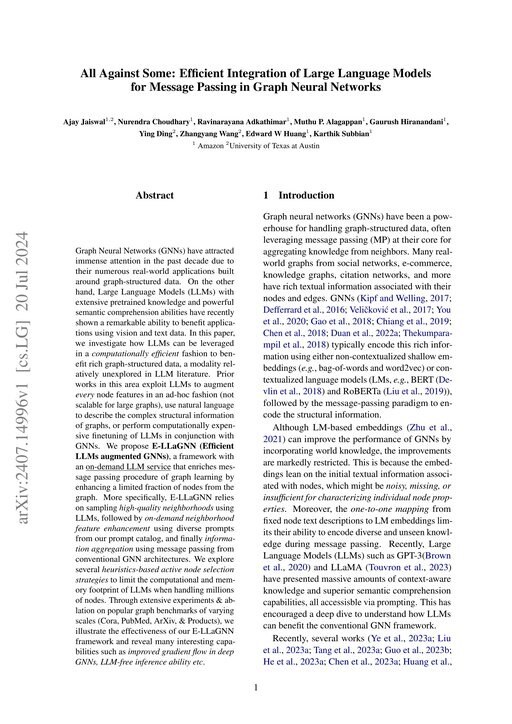
Graph Neural Networks (GNNs) have attracted immense attention in the past decade due to their numerous real-world applications built around graph-structured data. On the other hand, Large Language Models (LLMs) with extensive pretrained knowledge and powerful semantic comprehension abilities have recently shown a remarkable ability to benefit applications using vision and text data. In this paper, we investigate how LLMs can be leveraged in a computationally efficient fashion to benefit rich graph-structured data, a modality relatively unexplored in LLM literature. Prior works in this area exploit LLMs to augment every node features in an ad-hoc fashion (not scalable for large graphs), use natural language to describe the complex structural information of graphs, or perform computationally expensive finetuning of LLMs in conjunction with GNNs. We propose E-LLaGNN (Efficient LLMs augmented GNNs), a framework with an that enriches message passing procedure of graph learning by enhancing a limited fraction of nodes from the graph. More specifically, E-LLaGNN relies on sampling high-quality neighborhoods using LLMs, followed by on-demand neighborhood feature enhancement using diverse prompts from our prompt catalog, and finally information aggregation using message passing from conventional GNN architectures. We explore several heuristics-based active node selection strategies to limit the computational and memory footprint of LLMs when handling millions of nodes. Through extensive experiments & ablation on popular graph benchmarks of varying scales (Cora, PubMed, ArXiv, & Products), we illustrate the effectiveness of our E-LLaGNN framework and reveal many interesting capabilities such as improved gradient flow in deep GNNs, LLM-free inference ability etc.
Benchmark Results
Tested on 4 datasets 8 baseline values reported too low
Tables show presented results in global context (best 3 papers + GCN + MLP).
Classic
| # | Model | Accuracy ↑ | Paper |
|---|---|---|---|
| 1 | GraphSAGE+CNA | 0.9418
±0.0033 | |
| 2 | GCN+CNA | 0.9366
±0.0048 | |
| 3 | TransformerConv | 0.9350
±0.0058 | |
| 21 | GCN | 0.9004 best reported | best at pub: Understanding Heterophily for Graph Neural Networks (ICML 2024) |
| 39 | SAGE | 0.8911
±0.0012 | |
| 44 | GAT | 0.8897
±0.0014 best reported | best at pub: Learned Low Precision Graph Neural Networks (2020) |
| 45 | GCNII | 0.8893
±0.0137 best reported | best at pub: Language is All a Graph Needs (2023) best today: Large Language Model Meets Graph Neural Network in Knowledge Distillation (AAAI 2024) |
| 55 | JKNet | 0.8870 best reported | best at pub: Learned Low Precision Graph Neural Networks (2020) |
| 115 | E-LLaGNN | 0.8760
±0.0120 | This paper |
| 223 | SGC | 0.8509
±0.0648 best reported | best at pub: LOGIN: A Large Language Model Consulted Graph Neural Network Training Framework (2024) Difference within reported uncertainty; not counted as underperformance. |
| 691 | IncGCN | 0.7920 | This paper |
| 724 | MLP | 0.7768 |
| # | Model | Accuracy ↑ | Paper |
|---|---|---|---|
| 1 | LGTL | 0.9518
±0.0011 | |
| 2 | MixHop (LO) | 0.9513
±0.0038 | |
| 3 | GraphSAGE (LO) | 0.9511
±0.0036 | |
| 18 | GCN | 0.9296
±0.0015 best reported | best at pub: Node Identifiers: Compact, Discrete Representations for Efficient Graph Learning (ICLR 2024) |
| 20 | GAT | 0.9233
±0.0018 best reported | best at pub: Tackling Over-Smoothing for General Graph Convolutional Networks (2020) |
| 24 | JKNet | 0.9160 best reported | best at pub: Tackling Over-Smoothing for General Graph Convolutional Networks (2020) |
| 59 | E-LLaGNN | 0.9030
±0.0010 | This paper |
| 58 | GCNII | 0.9030
±0.0043 best reported | best at pub: Feature Transportation Improves Graph Neural Networks (AAAI 2023) |
| 116 | SAGE | 0.8881
±0.0015 | |
| 132 | IncGCN | 0.8850 | This paper |
| 141 | SGC | 0.8832
±0.0055 best reported | best at pub: LOGIN: A Large Language Model Consulted Graph Neural Network Training Framework (2024) Difference within reported uncertainty; not counted as underperformance. |
| 210 | MLP | 0.8690
±0.0074 |
OGB
| # | Model | Accuracy ↑ | Paper |
|---|---|---|---|
| 1 | Jacobi | 0.8968 | |
| 2 | GPR | 0.8953 | |
| 3 | LEMP4HG | 0.8939 | |
| 4 | SAGE | 0.8933 | |
| 83 | GraphSAGE | 0.8287 best reported | best at pub: A Comprehensive Study on Large-Scale Graph Training: Benchmarking and Rethinking (NeurIPS 2022) best today: Clustering as Reasoning: A $k$-Means Interpretation of Chain-of-Thought Graph Learning (ICML 2026) |
| 99 | E-LLaGNN | 0.8201
±0.0033 | This paper |
| 262 | LADIES | 0.7531
±0.0056 | This paper |
| 308 | FastGCN | 0.7346
±0.0020 | This paper |
| 351 | MLP | 0.6605
±0.0020 |
| # | Model | Accuracy ↑ | Paper |
|---|---|---|---|
| 1 | GIANT-XRT | 0.7612
±0.0016 | |
| 2 | GEGCN | 0.7576
±0.0064 | |
| 3 | AGDN | 0.7522
±0.0007 | |
| 23 | GCN | 0.7300
±0.0017 | |
| 25 | GraphSAGE | 0.7155
±0.0041 | prev best: Hierarchical Graph Transformer with Adaptive Node Sampling (NeurIPS 2022) best today: Geometric Evolution Graph Convolutional Networks: Enhancing Graph Representation Learning via Ricci Flow (2026) Improvement within reported uncertainty; not highlighted. |
| 100 | FastGCN | 0.6610
±0.0106 | This paper |
| 105 | LADIES | 0.6278
±0.0089 | This paper |
| 107 | MLP | 0.5765
±0.0012 |