GFT: Graph Foundation Model with Transferable Tree Vocabulary
Abstract
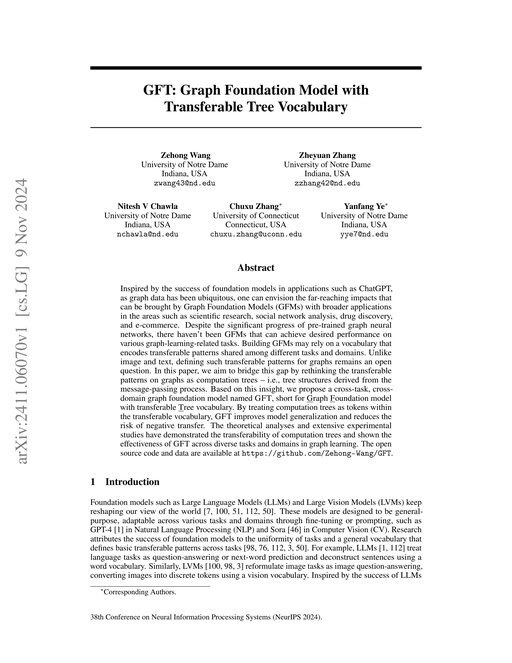
Inspired by the success of foundation models in applications such as ChatGPT, as graph data has been ubiquitous, one can envision the far-reaching impacts that can be brought by Graph Foundation Models (GFMs) with broader applications in the areas such as scientific research, social network analysis, drug discovery, and e-commerce. Despite the significant progress of pre-trained graph neural networks, there haven’t been GFMs that can achieve desired performance on various graph-learning-related tasks. Building GFMs may rely on a vocabulary that encodes transferable patterns shared among different tasks and domains. Unlike image and text, defining such transferable patterns for graphs remains an open question. In this paper, we aim to bridge this gap by rethinking the transferable patterns on graphs as computation trees -- i.e., tree structures derived from the message-passing process. Based on this insight, we propose a cross-task, cross-domain graph foundation model named GFT, short for raph oundation model with transferable ree vocabulary. By treating computation trees as tokens within the transferable vocabulary, GFT improves model generalization and reduces the risk of negative transfer. The theoretical analyses and extensive experimental studies have demonstrated the transferability of computation trees and shown the effectiveness of GFT across diverse tasks and domains in graph learning. The open source code and data are available at.
Benchmark Results
Tested on 1 dataset
Tables show presented results in global context (best 3 papers + GCN + MLP).
Knowledge Graphs
WN18RR
Global leaderboard →Default metric is MRR. The paper reports 3 values on MRR , 5 values on MRR (Link Classification header) and 1 value on MRR (Link Classification header; source does not print 'MRR' literally) .
| # | Model | MRR ↑ default | MRR (Link Classification header) ↑ | MRR (Link Classification header; source does not print 'MRR' literally) ↑ | Paper |
|---|---|---|---|---|---|
| 107 | GFT | —
| 0.9191 | — | MRR (Link Classification header)
0.9191 MRR (Link Classification header; source does not print 'MRR' literally)
— |
| 1 | GIANT | —
| 0.8436 | — | MRR (Link Classification header)
0.8436 MRR (Link Classification header; source does not print 'MRR' literally)
— |
| 1 | FedSage | 0.8426
±
0.0026 | — | — | MRR (Link Classification header)
— MRR (Link Classification header; source does not print 'MRR' literally)
— |
| 2 | FED-PUB | 0.8348
±
0.0025 | — | — | MRR (Link Classification header)
— MRR (Link Classification header; source does not print 'MRR' literally)
— |
| 3 | FedAvg | 0.8252
±
0.0023 | — | — | MRR (Link Classification header)
— MRR (Link Classification header; source does not print 'MRR' literally)
— |
| 4 | GAT | 0.8244
±0.0037 best reported | — | — | MRR (Link Classification header)
— MRR (Link Classification header; source does not print 'MRR' literally)
— |
| 6 | Linear | 0.8225
±0.0023 best reported | — | — | MRR (Link Classification header)
— MRR (Link Classification header; source does not print 'MRR' literally)
— |
| 7 | GCN | 0.8171
±0.0030 best reported | — | — | MRR (Link Classification header)
— MRR (Link Classification header; source does not print 'MRR' literally)
— |
| 8 | GraphSAGE | 0.8152
±
0.0024 | — | — | MRR (Link Classification header)
— MRR (Link Classification header; source does not print 'MRR' literally)
— |
| 102 | GraphMAE | —
| 0.7899 | — | MRR (Link Classification header)
0.7899 MRR (Link Classification header; source does not print 'MRR' literally)
— |
| 11 | DGI | —
| 0.7575 | — | MRR (Link Classification header)
0.7575 MRR (Link Classification header; source does not print 'MRR' literally)
— |
| 101 | BGRL | —
| 0.7544 | — | MRR (Link Classification header)
0.7544 MRR (Link Classification header; source does not print 'MRR' literally)
— |
| 9 | GIN | —
| — | 0.7402 | MRR (Link Classification header)
— MRR (Link Classification header; source does not print 'MRR' literally)
0.7402 |