Graph is a Substrate Across Data Modalities
Abstract
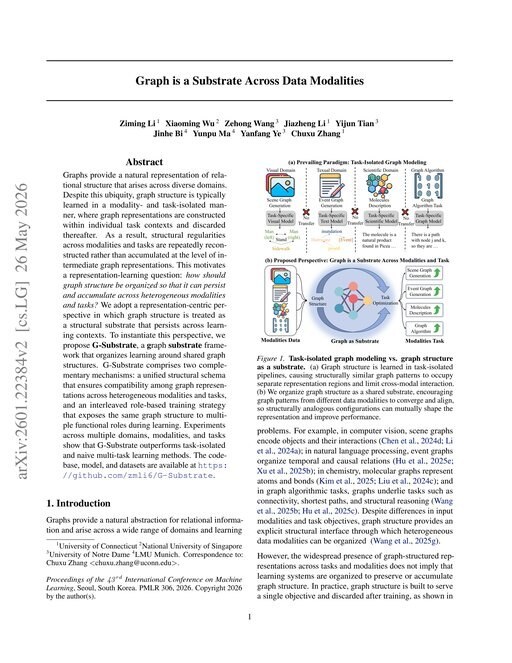
Graphs provide a natural representation of relational structure that arises across diverse domains. Despite this ubiquity, graph structure is typically learned in a modality- and task-isolated manner, where graph representations are constructed within individual task contexts and discarded thereafter. As a result, structural regularities across modalities and tasks are repeatedly reconstructed rather than accumulated at the level of intermediate graph representations. This motivates a representation-learning question: how should graph structure be organized so that it can persist and accumulate across heterogeneous modalities and tasks? We adopt a representation-centric perspective in which graph structure is treated as a structural substrate that persists across learning contexts. To instantiate this perspective, we propose G-Substrate, a graph substrate framework that organizes learning around shared graph structures. G-Substrate comprises two complementary mechanisms: a unified structural schema that ensures compatibility among graph representations across heterogeneous modalities and tasks, and an interleaved role-based training strategy that exposes the same graph structure to multiple functional roles during learning. Experiments across multiple domains, modalities, and tasks show that G-Substrate outperforms task-isolated and naive multi-task learning methods. The codebase, model, and datasets are available at https://github.com/zmli6/G-Substrate.
Benchmark Results
Tested on 1 dataset
Tables show presented results in global context (best 3 papers + GCN + MLP).
GraphBench
| # | Model | Accuracy ↑ | Paper |
|---|---|---|---|
| 1 | Naive multi-task | 0.9971 | This paper |
| 2 | Naive single-task | 0.9944 | This paper |
| 3 | G-Substrate | 0.9841 | This paper |
| 4 | Naive multi-task + interleave | 0.9827 | This paper |
| 5 | GITA | 0.9817 | This paper |
| 6 | Unified multi-task | 0.9809 | This paper |
| 7 | Unified single-task | 0.9780 | This paper |
| 8 | G-Wiz | 0.9774 | This paper |