Clustering as Reasoning: A $k$-Means Interpretation of Chain-of-Thought Graph Learning
Abstract
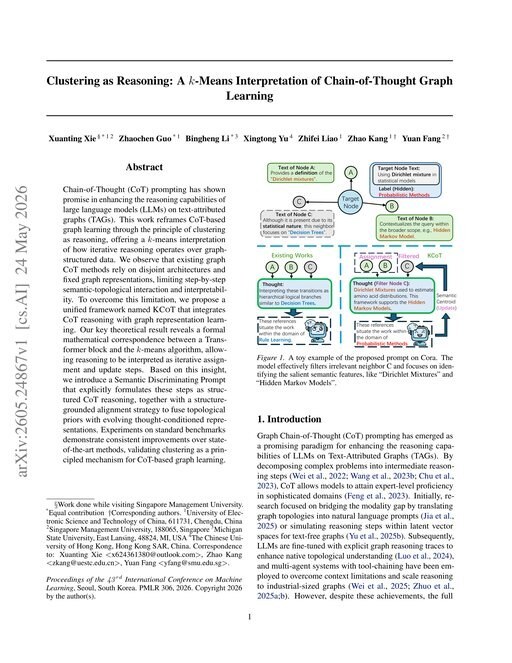
Chain-of-Thought (CoT) prompting has shown promise in enhancing the reasoning capabilities of large language models (LLMs) on text-attributed graphs (TAGs). This work reframes CoT-based graph learning through the principle of clustering as reasoning, offering a $k$-means interpretation of how iterative reasoning operates over graph-structured data. We observe that existing graph CoT methods rely on disjoint architectures and fixed graph representations, limiting step-by-step semantic-topological interaction and interpretability. To overcome this limitation, we propose a unified framework named KCoT that integrates CoT reasoning with graph representation learning. Our key theoretical result reveals a formal mathematical correspondence between a Transformer block and the $k$-means algorithm, allowing reasoning to be interpreted as iterative assignment and update steps. Based on this insight, we introduce a Semantic Discriminating Prompt that explicitly formulates these steps as structured CoT reasoning, together with a structure-grounded alignment strategy to fuse topological priors with evolving thought-conditioned representations. Experiments on standard benchmarks demonstrate consistent improvements over state-of-the-art methods, validating clustering as a principled mechanism for CoT-based graph learning.
Benchmark Results
Tested on 1 dataset 3 baseline values reported too low
Tables show presented results in global context (best 3 papers + GCN + MLP).
OGB
| # | Model | Accuracy ↑ | Paper |
|---|---|---|---|
| 1 | Jacobi | 0.8968 | |
| 2 | GPR | 0.8953 | |
| 3 | LEMP4HG | 0.8939 | |
| 4 | SAGE | 0.8933 | |
| 9 | GAT | 0.8829 best reported | |
| 14 | SAGN | 0.8736
±0.0007 best reported | best at pub: Learning on Large-scale Text-attributed Graphs via Variational Inference (ICLR 2022) |
| 49 | LLAGA-HO | 0.8467 | |
| 50 | LLAGA-ND | 0.8460 | |
| 66 | NodeFormer | 0.8372 | prev best: Efficient Tuning and Inference for Large Language Models on Textual Graphs (IJCAI 2024) |
| 83 | GraphSAGE | 0.8287 | prev best: A Comprehensive Study on Large-Scale Graph Training: Benchmarking and Rethinking (NeurIPS 2022) |
| 94 | SGC | 0.8220
±0.0090 best reported | best at pub: PaSca: a Graph Neural Architecture Search System under the Scalable Paradigm (WWW 2022) |
| 351 | MLP | 0.6605
±0.0020 |